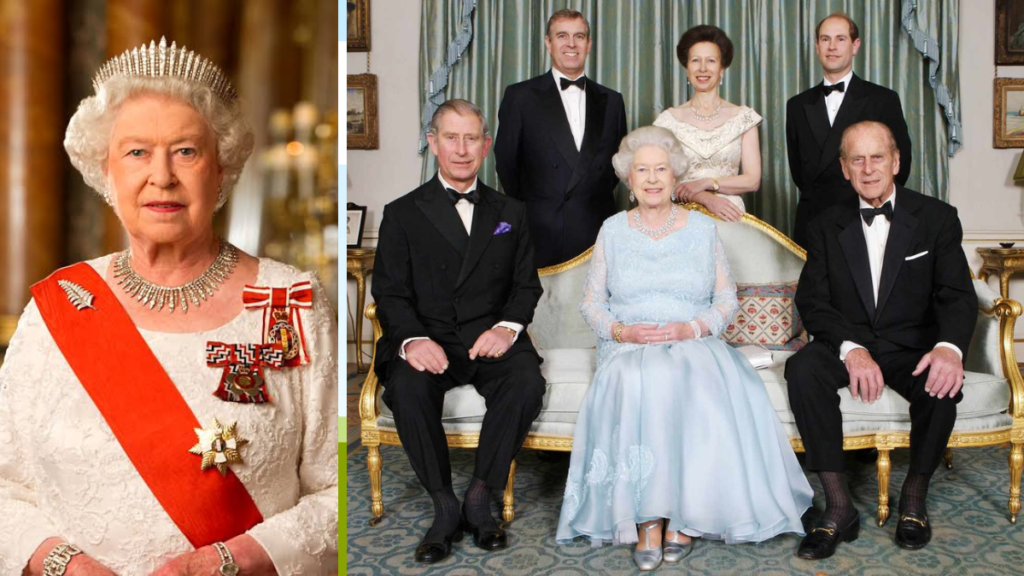

Queen Elizabeth II was one of the most recognisable monarchs in modern history, serving as the United Kingdom’s queen for more than seventy years. Throughout her remarkable reign, she balanced the responsibilities of the Crown with her role as a wife, mother, grandmother and great-grandmother. Although millions of people followed her public duties, her family life also attracted considerable attention, particularly as her children grew up under the intense scrutiny that comes with being part of the British royal family.
The story of queen elizabeth children offers a fascinating look at the people who helped shape the modern House of Windsor. Queen Elizabeth II and her husband, Prince Philip, Duke of Edinburgh, had four children: King Charles III, Princess Anne, Prince Andrew and Prince Edward. Each developed a different personality, pursued different interests and experienced the challenges of royal life in their own way.
Their lives have included military service, charitable work, international diplomacy, family responsibilities and public controversies. While the eldest son eventually became king, his siblings established their own roles within the monarchy and the wider royal family. Their experiences also reveal how the expectations placed on royal children have changed across generations.
This comprehensive guide explores the names, birth dates, careers, marriages and family lives of Elizabeth II’s four children, explaining how each contributed to the history of the British monarchy.
How Many Children Did Queen Elizabeth II Have?
Queen Elizabeth II had four children with Prince Philip. Their names are Charles, Anne, Andrew and Edward, and they were born between 1948 and 1964. Charles, the eldest, became King Charles III following his mother’s death in September 2022. His siblings have continued to be associated with royal duties, charitable organisations and family life, although their individual responsibilities have differed significantly.
The family grew during a period of enormous change in Britain. Elizabeth became queen in February 1952, when Charles was just three years old and Anne was still a toddler. Andrew and Edward were born after she had already begun her reign, meaning their childhoods unfolded in a world where their mother was not simply a parent but also the constitutional head of state.
Despite their privileged upbringing, the children did not all follow identical paths. Charles was prepared from an early age to inherit the throne, Anne became known for her dedication to public service and equestrian interests, Andrew served in the Royal Navy, and Edward developed a career connected with the performing arts before concentrating on royal duties.
Their different experiences reflect the complicated relationship between private family life and public expectations in a hereditary monarchy. Each child had to establish an individual identity while remaining connected to an institution with centuries of tradition.
Queen Elizabeth II’s Four Children at a Glance
The following table provides a quick overview of the monarch’s children, including their birth dates, principal titles and prominent areas of activity.
| Child | Date of birth | Main title or role | Notable distinction |
|---|---|---|---|
| Charles III | 14 November 1948 | King Charles III | Became king in 2022 |
| Anne | 15 August 1950 | Princess Royal | Accomplished equestrian and dedicated working royal |
| Andrew | 19 February 1960 | Prince Andrew, Duke of York | Former Royal Navy officer |
| Edward | 10 March 1964 | Prince Edward, Duke of Edinburgh | Supports royal engagements and the Duke of Edinburgh’s Award |
Although all four children were born into the same family, their public positions have changed over time. Charles inherited the Crown, Anne became a respected representative of the monarchy, Andrew withdrew from public royal duties following controversy surrounding his associations and conduct, and Edward took on additional responsibilities as his parents grew older.
The table also highlights the age differences between the siblings. Charles and Anne were born relatively close together, while Andrew arrived almost a decade later and Edward was the youngest. These gaps meant the older children had already experienced much of their childhood before their younger brothers were born.
King Charles III: Queen Elizabeth’s Eldest Child
King Charles III was born on 14 November 1948 at Buckingham Palace in London. His birth took place four years before his mother became queen, when she was still Princess Elizabeth. As the eldest child of Elizabeth and Philip, Charles was first in the line of succession from birth and spent much of his life preparing for a future role that would eventually place him at the head of the British monarchy.
His childhood was different from that of many children because his future responsibilities were largely predetermined. He attended school in Britain and later studied at the University of Cambridge, where he earned a degree in history. He subsequently served in the Royal Navy and Royal Air Force, gaining experience outside the immediate routines of royal life.
Charles became Prince of Wales in 1958, although his investiture ceremony took place in 1969 at Caernarfon Castle in Wales. Over the following decades, he developed a public profile through environmental campaigning, architecture, traditional craftsmanship and charitable initiatives. His interest in sustainability and the natural environment became a defining feature of his work long before these subjects became mainstream political concerns.
His personal life also attracted intense public attention. In 1981, he married Lady Diana Spencer, who became Diana, Princess of Wales. They had two sons, Prince William and Prince Harry. The marriage ended in divorce in 1996, following years of public difficulties and media scrutiny. Diana died in a car crash in Paris in 1997, an event that deeply affected the royal family and the wider public.
Charles later married Camilla Parker Bowles in 2005. Following Elizabeth II’s death on 8 September 2022, he became king, while Camilla became queen. His accession marked the end of his long period as heir apparent and the beginning of a new chapter for the monarchy.
Among Elizabeth’s children, Charles had the most direct constitutional responsibility because he inherited the throne. His reign has involved maintaining royal traditions while addressing contemporary questions about the monarchy’s purpose, relevance and future.
Princess Anne: The Princess Royal and Her Public Service
Princess Anne was born on 15 August 1950 at Clarence House in London. She is the second child and only daughter of Queen Elizabeth II and Prince Philip. Although she was not destined to inherit the throne under the succession rules in place at the time of her birth, Anne developed a strong public identity through her commitment to charitable work, equestrian sport and royal engagements.
Anne attended Benenden School in Kent and became an accomplished horsewoman. Her passion for riding eventually led her to compete internationally. In 1976, she represented Great Britain in equestrian eventing at the Montreal Olympic Games, becoming the first member of the British royal family to compete in the Olympics. Her sporting career helped distinguish her from other senior royals and demonstrated her determination to pursue demanding goals outside conventional royal duties.
She married Captain Mark Phillips in 1973. The couple had two children, Peter Phillips and Zara Tindall. Both children have developed independent lives, and neither has a royal title. Anne and Mark Phillips divorced in 1992, and she married Vice Admiral Sir Timothy Laurence later that year.
Anne was appointed Princess Royal in 1987, a title traditionally given to the eldest daughter of the sovereign when it becomes available. She has spent decades supporting hundreds of charitable organisations, with particular involvement in health, education, emergency services, sport and international development. Her work with Save the Children and other organisations has helped establish her reputation as one of the monarchy’s most consistent public servants.
She has frequently been recognised for her demanding schedule and practical approach to royal duties. Rather than relying heavily on glamour or celebrity attention, Anne has built her public image around reliability, discipline and service.
Her position within the family is especially interesting because she has remained active without being the direct heir to the throne. Her example demonstrates that royal influence is not limited to the monarch or the person next in line to succeed.
Prince Andrew: The Duke of York
Prince Andrew was born on 19 February 1960 at Buckingham Palace. He was Queen Elizabeth II and Prince Philip’s third child and second son. His arrival came nearly ten years after Princess Anne’s birth, making him part of a younger generation of the royal household. He grew up during a period when the monarchy was becoming increasingly visible through television, international travel and expanding media coverage.
Andrew attended Gordonstoun School in Scotland, the same school attended by his elder brother Charles. He subsequently joined the Royal Navy and trained as a helicopter pilot. During the Falklands War in 1982, he served aboard HMS Invincible and carried out operational duties. His military service became an important part of his public identity and distinguished his early career from those of his siblings.
In 1986, Andrew married Sarah Ferguson, who became the Duchess of York. They had two daughters, Princess Beatrice and Princess Eugenie. The couple separated in 1992 and divorced in 1996, although they maintained a continuing family relationship. Both daughters have since established their own careers and family lives.
For many years, Andrew carried out official engagements and represented the United Kingdom in business and trade-related roles. However, his public reputation deteriorated significantly because of his association with convicted sex offender Jeffrey Epstein and allegations made by Virginia Giuffre, who accused Andrew of sexually abusing her when she was seventeen. Andrew denied the allegations. In 2022, he reached a civil settlement with Giuffre without admitting liability. The settlement was not a criminal conviction or a judicial finding that the allegations were proven.
Andrew withdrew from public royal duties in 2019 following an interview about his relationship with Epstein. In January 2022, Buckingham Palace announced that his military affiliations and royal patronages had been returned to the queen and that he would no longer undertake public duties as a member of the royal family.
His circumstances illustrate how public trust can affect a royal’s position even when that person was born into the institution. Although Andrew remains Elizabeth II’s son, his role in the monarchy has become substantially more limited than it was during his earlier career.
Prince Edward: The Youngest Child of Queen Elizabeth II
Prince Edward was born on 10 March 1964 at Buckingham Palace. He was the youngest of Elizabeth II’s four children and arrived when his mother had already been queen for more than a decade. His childhood therefore unfolded within an established royal household, and he grew up with older siblings who had already begun to develop their own public identities.
Edward attended Gordonstoun School in Scotland before studying at Jesus College, Cambridge, where he graduated with a degree in history in 1986. After university, he briefly explored a career in entertainment and worked in television production. His involvement in the arts offered a different professional direction from the military careers pursued by his father and older brother Andrew.
In 1993, Edward established Ardent Productions, a television production company. His business interests eventually attracted scrutiny, and he left the company in 2002 to concentrate on royal responsibilities. His experience outside the traditional royal path helped shape a public role that combined his personal interests with official service.
Edward married Sophie Rhys-Jones in 1999. Sophie became the Countess of Wessex, and the couple had two children, Lady Louise Windsor and James, Earl of Wessex. In 2023, Edward was granted the title Duke of Edinburgh, previously associated with his father, Prince Philip. The title was granted by King Charles III and is held by Edward during his lifetime under the arrangements announced at the time.
Edward has supported numerous charitable organisations and has played an important role in the Duke of Edinburgh’s Award programme, an initiative founded by his father to encourage young people to develop confidence, practical skills and a sense of responsibility. His involvement with the award has included international visits and engagements with participants.
As the youngest child, Edward was never expected to become king under the normal course of succession. Nevertheless, his steady participation in public duties has become increasingly valuable to the royal family, particularly as other senior members have reduced their official workloads.
Queen Elizabeth II and Prince Philip’s Approach to Family Life
Queen Elizabeth II and Prince Philip married on 20 November 1947, more than a year before Charles was born. Their marriage lasted more than seventy-three years, ending with Philip’s death on 9 April 2021. Together, they raised four children while managing the demands of public service, international travel, constitutional responsibilities and the constant attention of the press.
Parenting within the royal household was not always straightforward. Elizabeth’s responsibilities as monarch frequently required her to travel or attend official engagements, while Philip took an active interest in his children’s education and development. Like many families, the Windsors experienced disagreements, changing expectations and the difficulty of balancing work with time at home.
Royal biographies and interviews have often explored the tension between tradition and modern parenting within the family. Charles’s education at Gordonstoun, for example, reflected Philip’s belief in resilience and independence. The experience was not always easy for Charles, who later described aspects of his school years as difficult.
The younger children grew up as the monarchy adapted to a more media-focused era. Television coverage of royal events made the family more accessible to the public, but it also increased the scrutiny placed on their private lives. Weddings, divorces, parenting decisions and personal difficulties became subjects of widespread discussion.
Elizabeth’s public role required her to maintain constitutional neutrality and represent national continuity. This did not mean her family life was free from emotion or personal challenges. Rather, the royal family had to manage many private experiences while recognising that their actions could have public consequences.
Prince Philip died in 2021, and Elizabeth died the following year. Their deaths marked the end of an era for the family and brought renewed attention to the relationships among their children, grandchildren and great-grandchildren.
How the Royal Succession Affected Elizabeth’s Children
The royal succession has played a major role in shaping the lives of Elizabeth II’s children. Under the rules that applied when Charles and Anne were born, male heirs took precedence over their older sisters. As a result, Charles remained ahead of Anne in the line of succession despite being only two years older.
The rules changed for people born after 28 October 2011 under legislation implemented in the United Kingdom through the Succession to the Crown Act 2013. The change introduced absolute primogeniture for those born after the relevant date, meaning that birth order takes precedence over sex. This reform did not alter the positions of Elizabeth’s existing children in the succession.
Charles became king immediately upon his mother’s death in September 2022. His eldest son, Prince William, became heir apparent, and William’s eldest child, Prince George, became second in line to the throne. The succession therefore continued through Charles’s branch of the family.
Anne’s descendants have no royal titles simply by virtue of being her children, and their places in the succession are separate from their public visibility. Andrew’s daughters, Beatrice and Eugenie, retain princess titles and remain in the line of succession, while Edward’s children have their own positions within the wider family.
The distinction between public duties and constitutional succession is important. Being high in the line of succession does not automatically mean a person carries out a large number of official engagements, while someone farther down the line may still perform important work on behalf of the monarch.
The Grandchildren and Great-Grandchildren of Queen Elizabeth II
Elizabeth II’s four children gave her eight grandchildren. Charles had William and Harry with Diana, Princess of Wales. Anne had Peter Phillips and Zara Tindall with Mark Phillips. Andrew had Beatrice and Eugenie with Sarah Ferguson, while Edward had Lady Louise Windsor and James, Earl of Wessex, with Sophie.
These grandchildren have followed different paths. William and Harry became internationally recognised figures because of their positions in the line of succession and their extensive public profiles. William married Catherine Middleton in 2011, and their children are Prince George, Princess Charlotte and Prince Louis. Harry married Meghan Markle in 2018, and they have two children, Prince Archie and Princess Lilibet.
Anne’s children have largely maintained independent professional and family lives. Peter Phillips has worked in business, while Zara Tindall has established a successful equestrian career and represented Great Britain at the Olympics. Their lives demonstrate that members of the royal family can remain connected to the institution without undertaking the same public responsibilities as senior working royals.
Beatrice and Eugenie have pursued careers outside the formal duties of the monarchy and have developed their own families. Edward’s children, Louise and James, have also grown up with a relatively lower public profile than the children of the direct heir.
Elizabeth’s great-grandchildren have become part of a new generation of the House of Windsor. Their childhoods are shaped by a royal family that has become more conscious of privacy, public expectations and the importance of allowing younger family members to develop their own interests.
The family tree also reveals the scale of Elizabeth’s legacy. Her descendants extend across several generations, with different levels of public responsibility and a variety of personal and professional interests.
The Public Legacy of Queen Elizabeth II’s Children
The four children of Elizabeth II have contributed to the monarchy in markedly different ways. Charles has taken on the ultimate responsibility of kingship, while Anne has become known for her long record of public service. Edward has supported charitable programmes and official engagements, whereas Andrew’s departure from public royal duties has highlighted the risks associated with controversy and public accountability.
Their experiences show that being born into the royal family does not guarantee an identical future. Each child has faced distinct expectations based on birth order, personal interests, public responsibilities and individual circumstances. These differences have become especially apparent as the monarchy has adapted to changing social attitudes.
The family has also experienced significant personal challenges, including marital breakdowns, bereavement, intense media scrutiny and disputes about the institution’s role. Such experiences have made the Windsors more recognisable to the public, but they have also raised questions about privacy, duty and the pressures of growing up in a famous family.
A useful way to understand their legacy is to consider the different forms of service they have provided. Constitutional leadership, charitable work, military experience and support for young people have all featured in the family’s history. Not every contribution has been equally successful or free from criticism, but together they illustrate the varied responsibilities associated with royal life.
Elizabeth’s children will remain an important part of the story of the modern British monarchy. Their lives connect the reign of the late queen with the reign of King Charles III and the generations expected to shape the institution in the future.
Frequently Asked Questions
How many children did Queen Elizabeth II have?
Queen Elizabeth II had four children with Prince Philip: Charles, Anne, Andrew and Edward. They were born in 1948, 1950, 1960 and 1964 respectively. Charles became King Charles III in September 2022, following the death of his mother.
Who was Queen Elizabeth II’s eldest child?
King Charles III was Queen Elizabeth II’s eldest child. Born on 14 November 1948, he became heir apparent when his mother ascended the throne in 1952. After spending more than seventy years preparing for kingship, he became monarch in September 2022.
Who was Queen Elizabeth II’s only daughter?
Princess Anne was Elizabeth II’s only daughter. Born on 15 August 1950, she became known for her equestrian achievements and extensive charitable work. She was appointed Princess Royal in 1987 and has remained one of the most active members of the royal family.
Did Queen Elizabeth II have any children before becoming queen?
Yes. Elizabeth had her first two children, Charles and Anne, before becoming queen in February 1952. Charles was three years old, and Anne was still a toddler when Elizabeth began her reign. Her younger sons, Andrew and Edward, were born after she became monarch.
Who was Queen Elizabeth II’s youngest child?
Prince Edward, Duke of Edinburgh, was the youngest of the four siblings. He was born on 10 March 1964 and later pursued television production before focusing on royal and charitable responsibilities. He married Sophie Rhys-Jones in 1999, and they have two children.
What happened to Prince Andrew after he left royal duties?
Prince Andrew withdrew from public royal duties in 2019 following controversy surrounding his association with Jeffrey Epstein. In 2022, his military affiliations and royal patronages were returned to the queen. He also reached a civil settlement with Virginia Giuffre without admitting liability, after denying her allegations of sexual abuse.
How many grandchildren did Queen Elizabeth II have?
Queen Elizabeth II had eight grandchildren: Prince William, Prince Harry, Peter Phillips, Zara Tindall, Princess Beatrice, Princess Eugenie, Lady Louise Windsor and James, Earl of Wessex. They have pursued a range of careers and family lives, with some undertaking more public royal responsibilities than others.
Which of Queen Elizabeth II’s children became king?
Charles was the only one of Elizabeth II’s children to become king. As her eldest son and heir apparent, he succeeded her immediately upon her death on 8 September 2022. His accession began a new reign and continued the monarchy’s hereditary succession through the House of Windsor.
Conclusion
The story of queen elizabeth children is central to understanding both the personal life of Queen Elizabeth II and the evolution of the British monarchy. Her four children, Charles, Anne, Andrew and Edward, grew up in a family where private experiences were often inseparable from public expectations. Each followed a different path, from kingship and charitable service to military life and the challenges of public controversy.
Their lives also connect several generations of the royal family. Charles’s accession to the throne, Anne’s decades of public service, Edward’s charitable commitments and the changing circumstances of Andrew have all influenced how the monarchy is viewed today. Through their children and grandchildren, Elizabeth and Philip’s family continues to shape the future of the House of Windsor.
Ultimately, their story demonstrates that the royal family is more than a line of succession. It is a family shaped by duty, personal choices, public expectations and changing times. Understanding the lives of Elizabeth II’s children provides a clearer picture of the people behind one of the world’s most enduring institutions.
Read also Jasmine Harman Net Worth: Career, Salary, Property Expertise and Wealth