
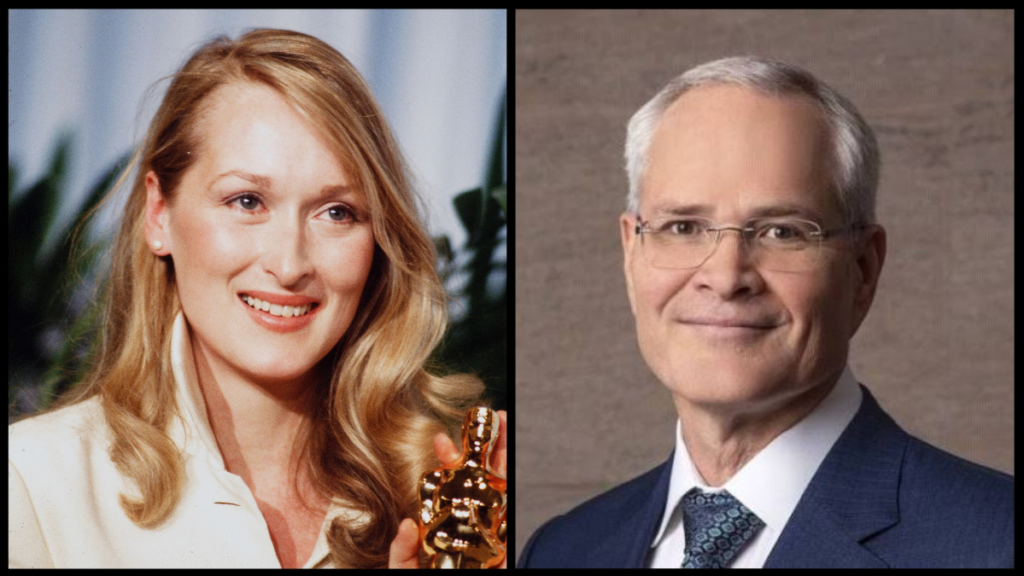

Meryl Streep and Darren Woods represent two very different worlds of professional achievement. Streep is one of the most celebrated actresses in film history, admired for her remarkable versatility, memorable performances, and decades of artistic excellence. Woods, meanwhile, is a prominent business executive known for leading ExxonMobil, one of the world’s largest publicly traded energy companies. Although their careers operate in separate industries, both have become influential figures whose decisions, work, and public profiles attract considerable attention.
The interest in Meryl Streep and Darren Woods reflects a broader curiosity about influential people and the ways their careers shape public life. One has built an extraordinary reputation through storytelling and character development, while the other has helped guide a major corporation through complex economic, technological, and environmental challenges. Their professional journeys provide an interesting opportunity to examine the different forms of leadership, ambition, and long-term success.
It is important, however, to distinguish between a meaningful comparison and a documented personal connection. Streep and Woods are not widely known as collaborators, relatives, or business partners. Their relevance to one another comes primarily from their individual prominence and the contrasting industries in which they have established their reputations.
Who Are Meryl Streep and Darren Woods?
Meryl Streep is an American actress celebrated for her ability to portray characters from different backgrounds, generations, and cultures. Her career includes critically acclaimed dramas, historical films, comedies, musicals, and commercially successful productions. She is widely recognized for her attention to accents, emotional detail, and character psychology, qualities that have made her a benchmark for acting excellence.
Darren Woods is an American business executive who became chairman and chief executive officer of ExxonMobil in January 2017. His professional background is rooted in engineering, finance, planning, and corporate management. Under his leadership, ExxonMobil has continued to focus on oil and natural gas production while investing in selected lower-emission technologies, including carbon capture and storage, hydrogen, and lithium-related opportunities.
The difference between their careers is immediately apparent. Streep communicates through characters, dialogue, and performances, while Woods operates through corporate strategy, capital investment, operations, and organizational leadership. Nevertheless, both work in environments where reputation matters and where sustained performance can influence how millions of people view their achievements.
Their stories also demonstrate that professional influence does not follow a single path. Recognition may come from artistic innovation, business performance, technical expertise, or the ability to guide an organization through periods of change.
Meryl Streep’s Early Life and Education
Born Mary Louise Streep on June 22, 1949, in Summit, New Jersey, Meryl Streep developed an interest in performance during her youth. She studied drama at Vassar College before continuing her education at the Yale School of Drama, where she received formal training in acting. Her education helped establish a foundation for the disciplined approach that later became one of her defining professional characteristics.
Streep’s early theatrical experiences allowed her to develop skills in voice, movement, emotional interpretation, and character analysis. Rather than relying on a single screen persona, she learned to approach each role as a distinct creative challenge. This preparation became especially valuable as she moved from stage productions into film and television.
Her early career included performances in theater and a growing number of screen roles. She gained substantial attention for The Deer Hunter in 1978 and received an Academy Award for Best Supporting Actress for Kramer vs. Kramer in 1980. These achievements helped establish her as a serious dramatic performer at a relatively early stage in her film career.
What distinguishes Streep’s development is the combination of formal training and practical experience. Her success was not simply the result of appearing in popular films. It came from consistently demonstrating the ability to inhabit complicated characters and contribute meaningfully to different kinds of stories.
Darren Woods’ Background and Professional Development
Darren Woods built his career through the corporate structure of ExxonMobil and its predecessor companies. He earned a bachelor’s degree in electrical engineering from Texas A&M University in 1982 and later completed an MBA at Northwestern University’s Kellogg School of Management in 1992. This combination of technical education and business training provided a foundation for work involving large-scale industrial operations and corporate decision-making.
Woods joined Exxon Company International in 1992. Over the following decades, he held positions involving planning, business development, refining, and other areas of the energy business. These responsibilities gave him exposure to the commercial and operational challenges of an industry shaped by global demand, commodity prices, technological developments, and geopolitical events.
His progression through the company eventually led to senior leadership responsibilities. Before becoming chief executive, he served as president of ExxonMobil and held important management positions that prepared him for the broader responsibilities of overseeing a multinational energy corporation.
Woods’ career illustrates a different kind of professional development from Streep’s. In the corporate world, advancement often depends on a combination of technical knowledge, financial judgment, management experience, and the ability to coordinate large teams. His rise demonstrates the importance of understanding both the operational details and the strategic direction of a complex business.
Meryl Streep and Darren Woods: A Comparison of Their Careers
Comparing Meryl Streep and Darren Woods offers a useful look at how professional achievement varies across industries. Streep’s reputation has been shaped by her performances, awards, collaborations with directors and fellow actors, and contribution to cinema. Woods’ reputation is more closely associated with corporate leadership, energy production, financial decisions, and the strategic direction of ExxonMobil.
Their professional environments also impose different expectations. An actress may be evaluated through artistic credibility, audience response, critical reception, and the cultural relevance of her work. A chief executive must consider operational safety, profitability, investment returns, regulatory requirements, workforce management, and long-term business resilience.
Despite these differences, both careers depend on sustained credibility. Streep has maintained her standing by adapting to changing roles and production styles. Woods must respond to changing energy markets, evolving technologies, shareholder expectations, and growing scrutiny of environmental performance.
The following table summarizes the main similarities and differences between their professional lives.
| Category | Meryl Streep | Darren Woods |
|---|---|---|
| Primary profession | Actress | Business executive |
| Main industry | Film, television, and theater | Energy and petroleum |
| Known for | Versatile performances and acclaimed roles | Leading ExxonMobil |
| Education | Vassar College and Yale School of Drama | Texas A&M University and Northwestern University |
| Major career milestone | Academy Award-winning performances | Appointment as ExxonMobil chairman and CEO in 2017 |
| Professional influence | Entertainment and popular culture | Global energy markets and corporate strategy |
| Core responsibilities | Interpreting characters and creating performances | Managing operations, investments, and corporate strategy |
| Common professional challenge | Maintaining artistic relevance | Navigating market, operational, and environmental pressures |
The table highlights why these individuals should not be treated as direct competitors. They operate in separate fields, pursue different objectives, and are assessed according to different measures of success. Their comparison is most useful as an exploration of professional excellence rather than as a contest over which career is more important.
Meryl Streep’s Most Influential Films and Performances
Streep’s filmography is notable for its range. In Sophie’s Choice (1982), she delivered an emotionally demanding performance that earned her the Academy Award for Best Actress. The film demonstrated her ability to portray profound psychological conflict while making a character’s experiences feel intimate and believable.
She later received widespread recognition for films including Out of Africa (1985), The Devil Wears Prada (2006), Doubt (2008), and The Iron Lady (2011). Her portrayal of Margaret Thatcher in The Iron Lady earned her another Academy Award for Best Actress, reinforcing her reputation for transforming herself to portray historical figures.
Her work in comedy and musicals further demonstrates her versatility. In Mamma Mia! (2008), she embraced a lighter, musical role, while Julie & Julia (2009) allowed her to combine humor with a distinctive character interpretation. These performances helped introduce her to audiences who may not have followed her earlier dramatic work.
Streep’s success also reflects an ability to work across generations of filmmakers and performers. She has moved between intimate dramas, large studio productions, political stories, and adaptations of literary material. Her continuing presence in major productions demonstrates that a long career can remain relevant when an artist is willing to explore different creative possibilities.
Darren Woods and His Leadership at ExxonMobil
ExxonMobil operates across multiple segments of the energy industry, including upstream oil and gas production, energy product manufacturing, and chemical products. Its scale means that decisions made by senior management can have substantial financial and operational consequences. As chief executive, Woods is responsible for setting corporate priorities, overseeing major investments, and balancing near-term business performance with longer-term strategic objectives.
One of the central issues facing Woods has been the changing outlook for global energy demand. Oil and natural gas continue to play significant roles in transportation, electricity generation, heating, manufacturing, and chemical production. At the same time, governments, investors, and consumers are increasingly focused on emissions reductions and the development of lower-carbon energy systems.
ExxonMobil’s strategy has included investments in conventional energy production as well as technologies intended to reduce or manage emissions. Carbon capture and storage, hydrogen, and other lower-emission business opportunities have featured in the company’s public plans. The commercial success of these initiatives depends on technology, infrastructure, policy, customer demand, and project economics.
Leadership in this environment involves balancing competing priorities. Investors often expect strong financial returns, while policymakers and communities expect responsible operations and credible environmental performance. Woods must also navigate changing regulations, competition, supply disruptions, and the possibility that energy demand and technology will evolve differently from current forecasts.
Different Approaches to Leadership and Influence
Meryl Streep and Darren Woods demonstrate that leadership can take many forms. Streep’s influence is largely creative and cultural. Through her performances, she can shape how audiences understand a historical figure, a family relationship, a workplace, or an ethical dilemma. Her work depends on collaboration, interpretation, emotional intelligence, and an understanding of human behavior.
Woods exercises influence through organizational leadership. His decisions can affect employees, suppliers, investors, customers, and the communities in which ExxonMobil operates. Corporate leadership requires translating broad objectives into investment decisions, operational plans, measurable performance targets, and practical responsibilities across a large organization.
There is also a difference in how their results are measured. An acclaimed performance can be remembered for decades even when a film’s immediate commercial success is modest. A corporate decision may be evaluated through financial results, production figures, safety performance, project execution, or changes in market conditions. Business results are often quantified, while artistic value can remain open to interpretation.
Neither model of influence is inherently superior. They serve different purposes and respond to different expectations. Streep’s career shows how creative work can endure through cultural change, while Woods’ role highlights the importance of making consequential decisions in an industry essential to the modern economy.
Public Recognition, Reputation, and Media Attention
Public recognition plays a significant role in the careers of both individuals, but it operates differently in entertainment and business. Streep is a familiar public figure because audiences encounter her work through films, interviews, award ceremonies, and cultural discussions. Her performances give viewers a direct way to evaluate her talent and form an emotional connection with her work.
Woods is more commonly discussed in connection with ExxonMobil’s financial performance, energy policy, investment strategy, and public statements. Although his position attracts considerable attention, much of that attention concerns the company he leads and the wider industry rather than his personal life.
The media environment also influences how their reputations develop. Actors may become associated with memorable roles that remain popular long after a film’s release. Executives are often judged according to the latest corporate results, major strategic announcements, market developments, and public controversies affecting their organizations.
For readers researching Meryl Streep and Darren Woods, it is helpful to separate established facts from assumptions. Public prominence does not establish a personal relationship, shared project, or private connection. Reliable information should identify what each person has actually done and explain why those achievements matter.
What Meryl Streep Teaches Us About Lasting Success
Streep’s career offers valuable lessons about preparation, adaptability, and the importance of continuing to develop professionally. Her ability to move between dramatic and comedic roles suggests that lasting success often requires more than mastering one particular skill. It also involves remaining curious, accepting new challenges, and being willing to approach familiar tasks from a different perspective.
Her achievements also demonstrate the value of collaboration. Film performances emerge from the combined efforts of actors, directors, screenwriters, editors, cinematographers, and many other professionals. Even an internationally recognized performer depends on a wider creative team to bring a story to the screen.
An often-used expression in acting is that a performer must understand a character before attempting to portray that person convincingly. Streep’s work illustrates this principle through her attention to speech patterns, physical mannerisms, emotional motivations, and personal history. Rather than simply presenting a character to an audience, she works to make the character’s behavior understandable within the story.
This approach offers a broader professional lesson: expertise becomes more valuable when it is supported by preparation and an openness to learning. Streep’s longevity shows how established talent can continue to develop instead of becoming limited by earlier achievements.
What Darren Woods’ Career Reveals About Corporate Leadership
Woods’ career offers a different set of lessons, particularly about long-term planning and decision-making under uncertainty. Energy companies frequently make investments that require substantial capital and take years to develop. Executives must consider future demand, operating costs, technological progress, regulations, and the possibility that market conditions may change before a project begins generating returns.
Another important aspect of corporate leadership is accountability. Large organizations affect employees, customers, investors, suppliers, and local communities. Their leaders must communicate strategic priorities clearly while ensuring that business operations follow relevant laws, safety standards, and environmental requirements.
ExxonMobil’s position in the global energy system also illustrates why corporate strategy cannot be separated from wider public concerns. Oil and gas remain important to many economies, but the climate impact of fossil fuels has prompted growing debate about the pace of the energy transition. Decisions concerning production, emissions, and investment therefore carry implications beyond a company’s immediate financial results.
The career of Woods demonstrates the complexity of managing an established industrial business during a period of technological and political change. His leadership can be assessed through corporate performance and the company’s response to these challenges, while recognizing that industry outcomes are influenced by factors beyond any single executive’s control.
Are Meryl Streep and Darren Woods Connected Professionally?
There is no widely documented professional partnership between Meryl Streep and Darren Woods. Streep is primarily associated with acting and the entertainment industry, whereas Woods is associated with ExxonMobil and the global energy sector. Their names appearing together in a search does not establish that they have worked together or share a business venture.
The distinction matters because online searches frequently bring together prominent people for comparison, general-interest articles, or discussions of influence. Sometimes two individuals are connected through a verified project, public event, family relationship, or business transaction. In other cases, the connection exists mainly because readers are interested in learning about both people.
A responsible account of Meryl Streep and Darren Woods should therefore focus on verifiable biographical information and the differences between their careers. It would be misleading to suggest a personal relationship, shared financial interests, or joint professional activity without credible evidence.
Their comparison remains interesting without such a connection. Streep represents achievement in a creative profession, while Woods represents leadership in a strategically important industrial sector. Their separate careers provide two distinct examples of how expertise and responsibility can shape a person’s public reputation.
The Broader Influence of Entertainment and Energy
Entertainment and energy may seem unrelated, but both industries influence everyday life. Films shape popular culture, preserve historical stories, and provide audiences with ways to explore emotions and social questions. Energy companies help supply the fuels, materials, and products used in transportation, manufacturing, construction, and other essential activities.
Streep’s work can influence how people interpret a story or remember a particular character. An effective performance can encourage audiences to consider experiences different from their own, while a successful film may become part of the cultural conversation for generations. Her contribution is therefore not limited to awards or box-office results.
Woods’ influence is more directly connected to the economic and industrial systems that support modern society. Energy production affects employment, trade, investment, prices, and national energy security. Corporate choices can also influence environmental outcomes, making transparency and responsible management important considerations.
The comparison between Meryl Streep and Darren Woods highlights the variety of ways people can become influential. Cultural influence often works through stories and shared experiences, while corporate influence operates through resources, infrastructure, employment, and strategic decisions. Both can be significant, although their effects are experienced and measured differently.
Quotes and Perspectives on Their Professional Legacies
Streep’s public remarks about acting and the arts have frequently emphasized empathy and the importance of understanding people whose experiences differ from one’s own. Her career reflects the value of examining human behavior rather than reducing characters to simple stereotypes. This is one reason her performances continue to attract attention from audiences, critics, and acting students.
Woods’ public leadership, by contrast, is generally communicated through ExxonMobil’s business priorities, investor discussions, and statements about energy supply and technology. These communications focus on the practical questions facing a large energy company: how to meet demand, invest capital, manage risk, and respond to changing environmental expectations.
These differences make it important to use quotations accurately. A quote should be attributed to the person who actually said it and presented in its original context. A general statement about ambition or leadership should not be presented as a direct quotation from either individual simply to make an article sound more authoritative.
Their professional legacies can be explored without relying on invented quotations. Streep’s body of work offers concrete examples of artistic interpretation and career longevity, while Woods’ executive responsibilities provide a basis for examining industrial leadership and the challenges of operating in a changing global economy.
Frequently Asked Questions
Who is Meryl Streep?
Meryl Streep is an American actress widely regarded as one of the most accomplished performers of her generation. She is known for her versatility, detailed character portrayals, and award-winning performances in films such as Sophie’s Choice, The Devil Wears Prada, and The Iron Lady.
Her career spans film, television, and theater, with roles ranging from historical figures to fictional characters in dramas, comedies, and musicals. Her continued recognition reflects her influence on modern acting and popular culture.
Who is Darren Woods?
Darren Woods is an American business executive who became chairman and chief executive officer of ExxonMobil in January 2017. He has spent much of his career in the energy industry, progressing through positions involving planning, business development, and corporate management.
He is known for overseeing the strategy of one of the world’s largest publicly traded energy companies. His responsibilities include managing investment priorities, operational performance, and the company’s response to changes in global energy markets.
Are Meryl Streep and Darren Woods related?
There is no widely established public information indicating that Meryl Streep and Darren Woods are related. They are recognized for separate professional careers, with Streep working primarily in entertainment and Woods leading a major energy corporation.
Their names may appear together in comparison-based searches, but that alone is not evidence of a family relationship. Reliable biographical sources should be used to verify any claimed personal connection.
Have Meryl Streep and Darren Woods worked together?
There is no widely documented collaboration between Meryl Streep and Darren Woods. Streep’s work centers on acting and film production, while Woods’ career focuses on corporate leadership and energy operations.
Although public figures from different industries can occasionally meet through events, charitable initiatives, or other activities, a specific connection should not be assumed without reliable documentation.
What is the main difference between Meryl Streep and Darren Woods?
The primary difference is their professional field. Streep is an actress whose reputation rests on her performances, artistic versatility, and contribution to cinema. Woods is a business executive whose role involves guiding ExxonMobil’s corporate strategy and overseeing its large-scale energy operations.
Their careers also demonstrate different forms of influence. Streep contributes to culture through storytelling and performance, whereas Woods influences business and industrial decisions through executive leadership.
Why are Meryl Streep and Darren Woods compared?
Interest in Meryl Streep and Darren Woods can be understood as a comparison of two prominent individuals from very different professional backgrounds. Their careers illustrate how people can achieve recognition through artistic excellence or corporate leadership.
However, the comparison should not be interpreted as evidence that they share a project or personal relationship. The most useful approach is to examine their individual achievements, responsibilities, and contributions to their respective industries.
What is Meryl Streep best known for?
Streep is best known for her extraordinary range as an actress and her ability to portray complex characters convincingly. Her performances in Sophie’s Choice, Out of Africa, Doubt, The Devil Wears Prada, and The Iron Lady demonstrate her ability to work across different genres and styles.
She has won three competitive Academy Awards and received numerous additional nominations and honors. Her long career has made her an important figure in discussions about acting technique, artistic development, and longevity in the film industry.
What does Darren Woods do at ExxonMobil?
As chairman and chief executive officer, Woods is responsible for the company’s overall direction, major business priorities, and executive leadership. ExxonMobil’s activities include oil and natural gas production, refining, energy products, and chemicals, alongside selected lower-emission technology initiatives.
His work involves balancing investment decisions, financial performance, operational responsibilities, and changing energy-market conditions. These challenges place his leadership within broader discussions about energy security, economic development, and environmental sustainability.
Conclusion
Meryl Streep and Darren Woods demonstrate two distinct paths to professional influence. Streep has earned lasting recognition through her performances, artistic versatility, and contribution to cinema. Woods has built his reputation through decades in the energy industry and his leadership of ExxonMobil, navigating the financial, operational, and environmental challenges facing a major global corporation.
Although their careers do not have a widely documented direct connection, comparing them offers a useful perspective on achievement across different industries. Their experiences show that professional success can emerge through creativity, technical knowledge, sustained effort, and the ability to respond to changing expectations.
Ultimately, the story of Meryl Streep and Darren Woods is best understood as a comparison of two influential careers rather than a claim of a personal or professional relationship. Their individual accomplishments illustrate how different forms of expertise can shape public life, influence institutions, and leave distinct legacies in entertainment and business.
Read also Leonardo DiCaprio and Emma Walmsley: Careers, Achievements, and Their Different Paths to Success