
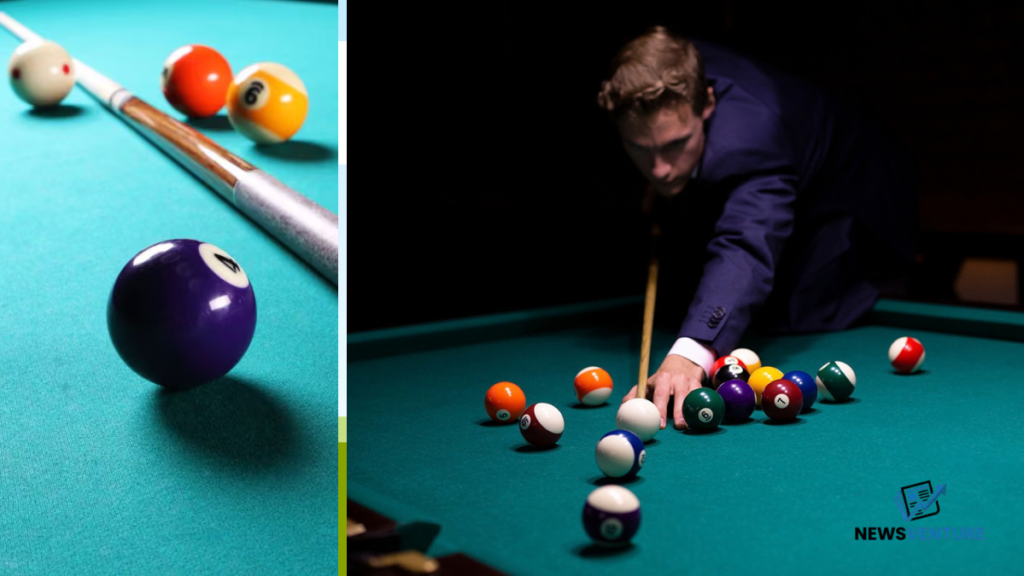

8 ball pool is one of the most recognizable cue sports in the world, combining simple rules with a surprisingly deep level of strategy. The basic idea is easy to understand: players use a cue stick to pocket their assigned group of balls and then legally pocket the black eight ball to win. What makes the game interesting is everything that happens between the opening break and the final shot.
Unlike games that depend almost entirely on speed or strength, 8 ball pool rewards patience, accuracy, planning, and control. A powerful shot may look impressive, but a carefully controlled cue ball can often be much more valuable. Good players think about their next shot before they even strike the current one.
The game can be played casually with friends, competitively in clubs and tournaments, or digitally through popular online pool games. Regardless of the setting, the fundamental skills remain similar. Understanding angles, controlling the cue ball, selecting the right shot, and managing pressure can dramatically improve performance.
For beginners, 8 ball pool provides an accessible introduction to cue sports. For experienced players, it offers endless opportunities to refine technique and develop advanced tactical skills. The table may look simple, but every shot creates a new position and a new decision.
Understanding the Basic Rules of 8 Ball Pool
The standard game uses a set of fifteen numbered object balls and a white cue ball. The object balls are divided into two groups: solids and stripes. One player normally plays solids, while the other plays stripes. The objective is to legally pocket all balls from your group before successfully pocketing the eight ball.
The opening break determines how the game develops. A strong break can spread the balls across the table and create several opportunities, but breaking hard is not automatically the best approach. Control, legal contact, and the resulting table layout all matter.
Once groups have been established, players attempt to pocket their own balls. A legal shot generally requires the cue ball to first contact an appropriate object ball and then result in a legal continuation of play. Specific rules can vary depending on the ruleset being used, so tournament play should always follow the regulations established for that event.
The eight ball has a special role. Pocketing it too early or illegally can result in losing the game under many common rulesets. That is why experienced players often treat the final stage differently from ordinary shots.
Why 8 Ball Pool Requires More Than Good Aim
Aiming is important, but accurate aiming alone does not make someone a strong pool player. A player can pocket difficult shots and still lose because the cue ball repeatedly finishes in poor positions. Position play is therefore one of the most important skills to develop.
After pocketing a ball, the cue ball needs to stop somewhere useful for the next shot. This means thinking about speed, spin, angles, and the natural path of the cue ball. A successful shot is not simply one that reaches the pocket. It should ideally leave a manageable opportunity for the next shot.
This is where the phrase “cue ball control” becomes especially important. Instead of treating every shot as an isolated challenge, skilled players see the table as a sequence. They consider the current shot, the next shot, and sometimes the shot after that.
Good players also understand when not to attempt a difficult shot. If a low-risk safety can put an opponent in trouble, that may be more valuable than attempting a low-percentage pocket. Pool is often a battle between opportunity and risk.
The Equipment Used for Better Gameplay
A standard pool setup consists of a regulation-style table, cue sticks, a cue ball, and a complete set of object balls. Table size, cloth condition, pocket dimensions, cue quality, and ball condition can all influence how the game feels.
A cue stick should feel comfortable in the player’s hands. Beginners do not necessarily need expensive equipment. A straight, well-maintained cue with a suitable tip can provide everything needed to learn proper fundamentals.
The table surface is equally important. Clean cloth allows the balls to travel more consistently, while worn or dirty cloth can affect speed and direction. Even small changes in table conditions can become noticeable when attempting long shots or delicate position play.
| Equipment | Main Purpose | What Beginners Should Look For |
|---|---|---|
| Cue stick | Striking the cue ball | Comfortable grip and straight shaft |
| Cue ball | Transfers force to object balls | Clean and properly weighted |
| Object balls | Targets used during play | Consistent size and condition |
| Pool table | Playing surface | Level surface and responsive cushions |
| Cue tip | Transfers energy to cue ball | Proper shape and good condition |
| Chalk | Improves tip contact | Consistent application before shots |
| Rack | Arranges balls for the break | Strong, even formation |
Good equipment supports better technique, but equipment cannot replace practice. A player with average equipment and excellent fundamentals can consistently outperform someone using expensive gear without proper control.
Learning Proper Stance and Cue Grip
A stable stance creates the foundation for accurate cueing. The feet should provide a comfortable base, while the body should remain balanced throughout the stroke. Players often develop different stances depending on their height, flexibility, and natural movement, but unnecessary tension should generally be avoided.
The grip should also remain relaxed. Holding the cue too tightly can restrict a smooth stroke and introduce unwanted movement. A relaxed grip allows the cue to travel naturally through the ball instead of being forced toward it.
The bridge hand provides another important point of stability. Whether using an open bridge or a closed bridge, the goal is to create a consistent path for the cue. A stable bridge helps keep the cue aligned with the intended shot line.
One useful principle is “smooth before powerful.” Beginners often focus on hitting harder when they miss a shot, but improving the stroke is usually more productive. A controlled, straight delivery can generate plenty of power without sacrificing accuracy.
Improving Aim and Understanding Angles
Pool balls move according to predictable physical principles, which means better understanding of angles can significantly improve accuracy. Instead of simply looking at the pocket and hoping the object ball goes there, players should visualize the path required to make the shot.
The contact point is particularly useful. Players can imagine where the cue ball needs to strike the object ball to send it toward the intended pocket. With practice, this becomes less conscious and more instinctive.
Cut shots are among the most common challenges. The thinner the contact between the cue ball and object ball, the more precise the shot becomes. Learning to recognize common cut angles makes the table easier to read.
The rails also influence shot planning. A ball can be sent toward a cushion and redirected toward a pocket, creating bank shots and more advanced positional opportunities. These shots require an understanding of rebound angles and speed.
Using Cue Ball Spin Effectively
Cue ball spin adds another layer of control to the game. Players can strike different areas of the cue ball to influence its movement after contact with an object ball. Common forms of spin include follow, draw, and side spin.
Follow is created by striking above the center of the cue ball. After contacting an object ball, the cue ball continues moving forward. Draw is produced by striking below center, causing the cue ball to travel backward after contact when executed correctly.
Side spin, often called English, changes the cue ball’s behavior as it interacts with cushions and other balls. It can be extremely useful, but beginners should avoid relying on it before developing a reliable center-ball stroke.
Spin should serve a purpose rather than being added simply because it looks advanced. If a simple center-ball shot produces the desired position, it is often preferable to introducing unnecessary complexity.
Planning Position Play Around the Table
Position play separates casual players from those who consistently run multiple balls. Instead of asking only where the object ball will go, the player must consider where the cue ball will finish.
The ideal position depends on the next object ball and the available pocket. A player may intentionally leave the cue ball at a particular angle so that the following shot becomes easier. This creates a chain of controlled movements across the table.
Planning also involves identifying problem balls. Some balls may be blocked by other objects, trapped near cushions, or positioned awkwardly. Clearing these balls early can prevent difficult situations later in the rack.
A strong player often works backward from the end of the sequence. If the eight ball requires a particular approach, the previous ball needs to provide access to that position. This backward planning is one of the most valuable strategic concepts in 8 ball pool.
Developing a Reliable Break Shot
The break begins the game and can have a major influence on the table layout. A good break requires a combination of cue ball speed, accurate contact, and control. Simply hitting the rack as hard as possible is not always the most effective approach.
Players should pay attention to where the cue ball finishes after the break. A scratch can immediately create a major disadvantage, while a controlled cue ball can provide a useful first opportunity.
Different rulesets and playing environments can encourage different breaking strategies. Competitive players often practice several break techniques and evaluate which one produces the most consistent results under specific conditions.
The break is also one of the best shots to practice separately. Because the setup is repeated, players can experiment with stance, cue speed, contact point, and follow-through while observing how small changes affect the rack.
Common Mistakes Beginners Should Avoid
One of the biggest beginner mistakes is rushing. Pool rewards deliberate preparation. Standing over the table for too long can create tension, but shooting immediately after approaching the table often leads to avoidable errors.
Another common problem is inconsistent cue alignment. If the cue is not traveling along the intended line, even a well-read shot can miss. Establishing the same pre-shot routine helps reduce this problem.
Beginners also frequently use excessive power. Strong shots can be useful, but they make the cue ball harder to control. Many positional shots require surprisingly little force.
Ignoring the next shot is another costly habit. A player may successfully pocket one ball while leaving the cue ball against a cushion or behind another object ball. The immediate success then creates a difficult second shot.
Finally, players sometimes attempt complicated shots when a simpler route is available. A good rule is to value consistency over unnecessary difficulty. The most impressive shot is not always the most useful shot.
Building a Practical Practice Routine
Effective practice does not have to mean spending hours randomly hitting balls. Structured repetition usually produces better results. A player can divide practice into different areas, such as straight shots, cut shots, position play, cue ball control, and safety play.
Start with simple shots to establish a consistent stroke. Gradually increase distance and angle as accuracy improves. This allows weaknesses to become visible without immediately introducing too many variables.
Position drills are particularly valuable. Pocket an object ball while attempting to leave the cue ball in a specific area. The goal is not just to make the shot but to control what happens afterward.
Another useful exercise is running several balls in sequence. Choose an achievable pattern and try to complete it without losing position. This develops planning skills and encourages players to think beyond the current shot.
Keeping practice purposeful makes improvement easier to measure. Instead of simply saying “I need to get better,” players can focus on specific targets such as improving long-shot accuracy or reducing cue ball scratches.
Defensive Strategy and Safety Play
Not every turn needs to end with an attempted pocket. Safety play can be an essential part of competitive pool. A well-executed safety can leave the opponent with limited options while giving you a chance to gain control of the table later.
Safety involves controlling both the cue ball and object balls. The goal may be to hide the cue ball behind another ball, place an object ball in an awkward position, or force the opponent to attempt a difficult shot.
This approach becomes especially important when the table does not offer a reasonable offensive opportunity. Trying a low-percentage shot can give the opponent an easy run if the attempt fails.
Strong defensive play requires patience. A player must be comfortable accepting a temporary lack of scoring in exchange for a better overall position. That strategic discipline is often what makes competitive matches more interesting.
Managing Pressure During Competitive Games
Pressure can affect even technically skilled players. A player who performs well during practice may suddenly become less accurate when every shot has greater consequences.
A consistent pre-shot routine can help. Walking into the shot, checking the line, settling the bridge, taking controlled practice strokes, and delivering the cue smoothly creates a familiar sequence.
Breathing and tempo also matter. Rushing because of nerves often produces a jerky stroke. Slowing down slightly can make the shot feel more manageable without creating excessive hesitation.
It is useful to focus on the process rather than the result. Instead of thinking about winning the rack, concentrate on executing the current shot correctly. This keeps attention on something controllable.
The phrase “one shot at a time” is particularly relevant in pool because every position depends on the previous decision. Staying focused on the current table layout prevents unnecessary distraction.
8 Ball Pool as an Online and Mobile Game
The popularity of digital pool has introduced the sport to millions of casual players. Online versions allow people to practice aiming, compete against opponents, collect virtual equipment, and experience different table environments from phones, tablets, and computers.
Digital gameplay can help players understand basic concepts such as shot angles, power control, and cue ball movement. It also makes repeated practice convenient because a complete match can be played without requiring access to a physical table.
However, physical and digital gameplay are not identical. Real tables introduce factors such as cloth speed, cushion response, lighting, stance, and tactile feedback. Online games may simplify or modify certain mechanics to make the experience more accessible.
For that reason, digital play is best viewed as its own form of pool entertainment while still offering useful opportunities to understand fundamental concepts.
Choosing the Right Strategy for Different Table Layouts
There is no single strategy that works perfectly on every table. The arrangement of the balls should influence the player’s decisions. An open table with clear pockets creates different opportunities from a crowded table containing several blocked paths.
Open tables often reward planning several shots ahead because the player has more freedom of movement. Crowded tables may require careful problem-solving and deliberate clearing of clusters.
Ball selection is another strategic consideration. A player should identify which balls are easiest to pocket and which could become problematic later. Taking the easiest available shot is not always ideal if it leaves a difficult final pattern.
The eight ball should also be considered throughout the rack. Strong players do not wait until the end to think about it. They gradually create the position needed to approach the final shot safely.
How to Become More Consistent
Consistency comes from repeating sound fundamentals rather than chasing spectacular shots. A straight stroke, stable stance, controlled speed, and reliable aiming process will produce better results over time.
Players should also review their mistakes without becoming frustrated. When a shot fails, identify the reason. Was the aim incorrect? Was the speed too high? Did the cue ball take an unexpected path? Was the selected shot unnecessarily difficult?
Keeping track of recurring errors can reveal patterns. Someone who repeatedly scratches in the same area may need to change speed or angle. Someone who misses long cuts may need to work on alignment and visualization.
Progress in 8 ball pool is rarely perfectly linear. Some sessions will feel excellent, while others may seem frustrating. Regular practice and attention to fundamentals generally matter more than occasional outstanding performances.
The Difference Between Casual and Competitive Play
Casual pool is often about entertainment, social interaction, and enjoying the challenge. Players may use house rules, experiment with difficult shots, or simply play without worrying about strict tactical decisions.
Competitive play tends to demand greater discipline. Players need to understand the applicable rules, control their emotions, manage time, and make decisions based on probability and table position.
The competitive environment also places greater importance on safety play and pattern selection. A single mistake can allow an opponent to clear the remaining balls.
That difference does not mean casual players need to adopt tournament-level seriousness. Learning competitive concepts can simply make recreational games more enjoyable by giving players a deeper appreciation of what happens on the table.
Why Strategy Matters as Much as Technique
Technical ability determines what shots a player can execute, while strategy determines which shots should be attempted. The two skills work together.
For example, a player might have the ability to make a difficult bank shot. If an easier safety or positional shot exists, attempting the bank may create unnecessary risk. Strategic thinking means evaluating the entire situation rather than focusing only on technical possibility.
Good strategy also includes risk management. When ahead, a player may choose conservative routes that protect the advantage. When behind, a more aggressive approach may sometimes be necessary.
Understanding these trade-offs helps transform pool from a sequence of individual shots into a complete tactical game.
Conclusion
8 ball pool combines straightforward rules with a depth that can keep players interested for years. The basic objective is easy to understand, but mastering the game requires much more than simply pocketing balls. Aim, cue ball control, position play, break technique, safety strategy, and mental discipline all contribute to stronger performance.
Beginners should focus on fundamentals rather than complicated tricks. A balanced stance, relaxed grip, smooth stroke, accurate alignment, and controlled speed provide a foundation for everything that comes later. As these skills improve, players can gradually introduce draw, follow, side spin, bank shots, pattern planning, and advanced defensive tactics.
The most important lesson is to think beyond the current shot. Every decision changes the next position on the table. Players who learn to plan ahead, recognize risk, and control the cue ball begin to see opportunities that are easy to miss at first.
Whether played casually with friends, in a pool hall, in competition, or through a digital platform, 8 ball pool remains an engaging cue sport because every rack presents a different challenge. With regular practice and a thoughtful approach, players can become more accurate, more consistent, and much more confident around the table.
Frequently Asked Questions
What is 8 ball pool?
8 ball pool is a cue sport played with a white cue ball and fifteen numbered object balls. Players are normally assigned either solids or stripes and must legally pocket their group before attempting to pocket the eight ball according to the applicable ruleset.
How do you improve at 8 ball pool?
Improvement comes from practicing fundamentals consistently. Work on stance, cue alignment, stroke control, aiming, speed, and cue ball positioning. Once these basics become reliable, introduce position drills, safety play, spin, and planned ball patterns.
Is 8 ball pool difficult to learn?
The basic rules are relatively easy for beginners to understand, but becoming highly skilled takes practice. The difficulty comes from controlling the cue ball, reading angles, planning several shots ahead, and making good decisions under pressure.
What is the most important skill in 8 ball pool?
Cue ball control is one of the most important skills because it determines where the cue ball finishes after each shot. Good control makes the following shot easier and allows players to build reliable patterns across the table.
How can beginners practice 8 ball pool effectively?
Beginners can practice straight shots, cut shots, cue ball stopping, follow, draw, and basic position play. It is more productive to repeat specific drills with a clear goal than to simply play random racks without examining mistakes.
Is breaking hard important in 8 ball pool?
Power can be useful during the break, but accuracy and control are also important. A powerful break that produces a scratch or an unfavorable cue ball position may create problems. The best approach depends on the table, equipment, and rules being used.
What is a safety shot in 8 ball pool?
A safety shot is a defensive play designed to make the opponent’s next shot difficult rather than directly attempting to pocket a ball. Effective safety play can involve hiding the cue ball, controlling object-ball positions, or limiting available shots.
Can spin improve your 8 ball pool game?
Yes. Follow, draw, and side spin can provide greater control over the cue ball and help players reach better positions. However, spin should be introduced gradually because excessive or poorly controlled English can make shots less predictable.
How long does it take to become good at 8 ball pool?
There is no fixed timeline because improvement depends on practice frequency, natural coordination, coaching, and the quality of practice. Players who consistently work on fundamentals and learn from their mistakes can make noticeable progress over time.
What makes a player consistent?
Consistency comes from repeatable fundamentals and good decision-making. A stable stance, smooth stroke, reliable aiming routine, controlled cue ball speed, and sensible shot selection reduce unnecessary errors and make performance more predictable.
Read also Electric Cars for Sale: A Complete Guide to Finding the Right EV