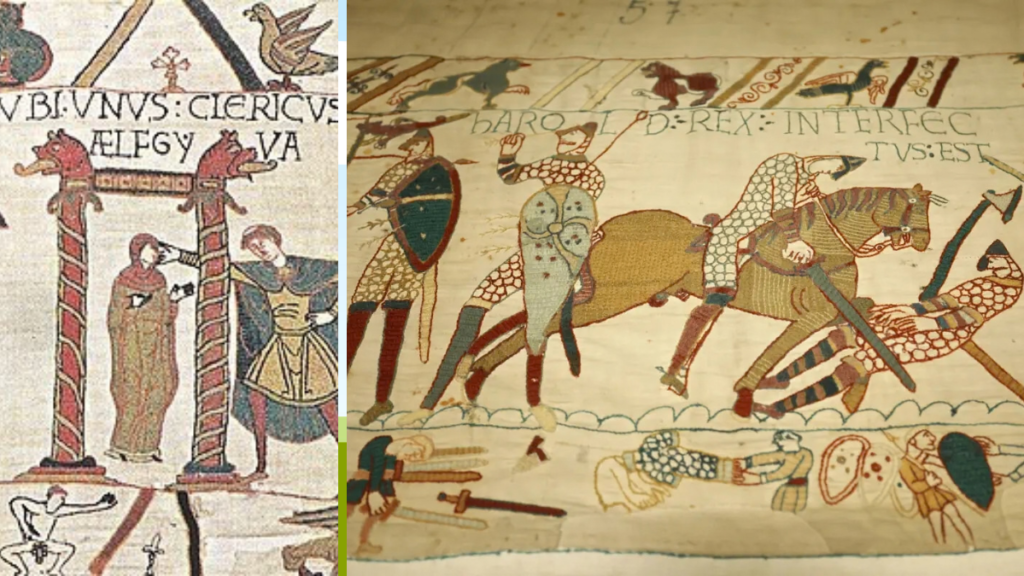

The Bayeux Tapestry is one of the most famous medieval artworks in Europe, and its arrival in the capital has turned an extraordinary piece of history into a major London cultural event. For the first time in almost 1,000 years, the original embroidered work is being displayed in England at the British Museum. The exhibition brings visitors face to face with a 70-metre-long account of the events surrounding the Norman Conquest of England in 1066.
For anyone searching for Bayeux Tapestry London, the attraction is not simply an old textile. It is a remarkable visual narrative filled with kings, soldiers, ships, horses, weapons, feasts, castles and dramatic scenes from one of the most important turning points in English history. The tapestry also provides clues about medieval clothing, architecture, warfare, transport and everyday life.
Why the Bayeux Tapestry is coming to London
The exhibition is taking place under a historic loan agreement between France and the United Kingdom. The tapestry normally belongs to the collections of the Bayeux Museum in Normandy, but that museum is undergoing a major renovation. The temporary move has created an exceptional opportunity for British visitors and international travellers to see the original work in England rather than travelling to France. This makes Bayeux Tapestry London a particularly significant cultural event for anyone interested in medieval history.
The British Museum is presenting the tapestry in the Sainsbury Exhibitions Gallery. The public exhibition runs from September 2026 to July 2027, making this a temporary opportunity rather than a permanent London attraction. The British Museum describes the loan as the first time the tapestry has returned to the country since it was made nearly 1,000 years ago.
The arrangement is also more than a simple museum loan. British treasures, including the Sutton Hoo finds and Lewis chess pieces, are travelling to France as part of the cultural exchange. This makes the exhibition an example of international cooperation as well as a major historical display.
What the Bayeux Tapestry actually tells
At the heart of the Bayeux Tapestry is the story of the Norman Conquest. Its scenes cover the political crisis that followed the death of Edward the Confessor, the claim to the English throne, Harold Godwinson’s journey, William of Normandy’s preparations, the Norman invasion and the Battle of Hastings.
The embroidery is especially valuable because it tells history visually. Medieval audiences did not have newspapers, photographs or television, yet the tapestry communicates movement and drama through hundreds of figures and carefully arranged scenes. The story unfolds almost like a long illustrated film strip, with ships crossing water, horses charging into battle and armies confronting one another.
The British Museum states that the work contains 58 scenes, 626 characters and 202 horses. It is embroidered in wool thread on linen and measures around 70 metres in length. These details help explain why the object is considered both an important historical source and a masterpiece of medieval art.
What you can see in the London exhibition
A visit to Bayeux Tapestry London is an opportunity to study far more than the famous Battle of Hastings scenes. The embroidery includes images of ships, armour, weapons, buildings, animals, clothing and food. Small details can be just as interesting as the central political story.
One of the pleasures of viewing the original is noticing how much information has been packed into the narrow linen surface. The upper and lower borders contain decorative imagery, including animals and objects, while the central narrative carries the main sequence of events. Some scenes are straightforward and dramatic; others reward slow observation.
The exhibition also places the tapestry within the wider world of 11th-century England and Normandy. Visitors can think about how people travelled, fought, worshipped, governed and lived. The tapestry is therefore useful not only for understanding 1066 but also for exploring medieval culture more broadly.
Why 1066 matters so much in English history
The year 1066 is one of the best-known dates in British history because the Norman Conquest transformed England’s political and social landscape. William, Duke of Normandy, defeated Harold Godwinson at the Battle of Hastings and eventually became King William I.
The consequences extended far beyond the battlefield. Norman rule influenced land ownership, government, military organisation, architecture and the development of the English language. Castles appeared across the country, while French and Latin became important languages of administration and elite culture.
The tapestry captures the period at a fascinating moment of transition. It shows English and Norman forces, but it also reveals shared medieval traditions. The result is not simply a record of one battle. It is a visual document about power, identity, technology and the way history was remembered.
The craftsmanship behind the historic embroidery
The phrase tapestry is widely used, but the Bayeux work is technically an embroidery rather than a woven tapestry. Wool threads were stitched onto linen, producing strong outlines and flat areas of colour. The simplicity of the materials makes the survival of such a large medieval textile particularly impressive.
The workmanship also reveals how much planning was required. A long narrative had to be designed, transferred and embroidered across a continuous piece of cloth. Figures needed to remain recognisable, while the sequence of scenes had to communicate a coherent story.
The British Museum notes that the work was likely commissioned by a Norman patron and made by English embroiderers, with manuscript drawings from Canterbury thought to have influenced its design. That combination makes the object especially interesting because its creation reflects connections between Normandy and England even before the conquest was complete.
Why seeing the original is different from seeing a replica
Reproductions of the Bayeux Tapestry have existed for generations, and they can be useful for schools, historians and anyone unable to travel. Digital versions are also excellent for examining individual scenes closely. Even so, the original offers something different.
Scale is a major part of the experience. A 70-metre artwork cannot be fully appreciated from a small photograph or textbook page. Seeing the linen, stitching and accumulated signs of age gives a better sense of the physical object and the extraordinary effort involved in preserving it.
The original also carries a historical presence that reproductions cannot completely recreate. British Museum director Nicholas Cullinan described the opportunity by saying that encountering it in person gives “a sense of absolute awe.”
Bayeux Tapestry London tickets and planning a visit
Demand for the exhibition is extremely high because this is a rare international loan and the first UK display of the original in nearly a millennium. The British Museum opened public ticket sales in July 2026 for visits from September through December, with later booking arrangements for 2027. The museum has also offered priority booking to members and supporters.
Anyone planning a visit should check the official British Museum exhibition page for the latest ticket release information, entry arrangements and availability. The exhibition is in the Sainsbury Exhibitions Gallery at the British Museum on Great Russell Street in London. Visitors interested in Bayeux Tapestry London should plan ahead because demand has been unusually strong.
Because the tapestry is a fragile historic textile, exhibition conditions are carefully controlled. Its movement from France involved specialist conservation and transport arrangements, including a climate-controlled, vibration-resistant case. French cultural authorities have emphasised the extensive preparation involved in moving the object safely.
How long does the exhibition take to explore
There is no single correct amount of time to spend with the tapestry. A quick visit can provide a strong overall impression, but a slower viewing allows visitors to notice individual figures, gestures, costumes and objects.
For first-time visitors, it helps to understand the broad story before entering the gallery. Knowing that the embroidery moves from the political crisis before the invasion toward the Battle of Hastings makes it easier to follow the sequence without becoming lost among hundreds of details.
It is also worth remembering that the tapestry is not a modern historical textbook. It was created in a particular political and cultural environment, so its presentation of events should be considered critically. Historians use it alongside written records, archaeology and other evidence rather than treating every scene as an objective photograph of the past.
What the tapestry reveals about medieval life
One reason the artwork remains so popular is its unusual amount of everyday information. The embroidered figures wear different types of clothing, soldiers carry distinctive weapons and ships show details of medieval seafaring. Buildings and furnishings also appear throughout the narrative.
Horses are particularly prominent. Their presence demonstrates how important mounted warfare was to Norman military power, while the depictions of infantry and shields help viewers imagine the organisation of a medieval army. The artwork also shows how people interacted with animals, vehicles and tools.
For modern audiences, these details can make the 11th century feel surprisingly tangible. Rather than reading a list of medieval objects, visitors can see them incorporated into a continuous story. This combination of art and historical evidence is a major reason the work remains so valuable to researchers and the public.
The controversial and mysterious side of the Bayeux Tapestry
The tapestry is famous, but many aspects of its history remain debated. Scholars have examined where it was made, who commissioned it, how closely its scenes reflect events and what messages its creators intended to communicate.
The work has often been associated with Odo, Bishop of Bayeux and half-brother of William the Conqueror, although questions about its exact origins and patronage continue to attract scholarly attention. Its viewpoint is also important. The narrative largely follows the Norman claim to the English throne, meaning viewers should consider whose perspective is being represented.
There are also gaps and damaged areas, particularly toward the end of the story. This means the surviving embroidery does not provide a complete account of the conquest. Its value comes partly from what it shows and partly from the questions it raises about medieval storytelling and political memory.
The relationship between London, England and Bayeux
The London exhibition creates a fascinating historical circle. The tapestry was made in the 11th century to tell a story involving England and Normandy, spent centuries associated with France, and has now returned temporarily to England. Bayeux Tapestry London therefore connects a modern capital with one of Europe’s most important medieval collections.
Its journey also demonstrates how cultural heritage can cross modern national borders. The events shown in the embroidery took place nearly a thousand years ago, when political identities were very different from those of modern Britain and France. Today, the tapestry belongs to a shared European historical story.
The cultural exchange accompanying the loan reinforces that idea. France is receiving important objects from the British Museum while the UK hosts the Bayeux Tapestry. The arrangement has been presented by both countries as an important act of cultural cooperation.
Key facts at a glance
| Feature | Information |
|---|---|
| Exhibition venue | British Museum, London |
| Gallery | Sainsbury Exhibitions Gallery |
| Exhibition period | September 2026 to July 2027 |
| Length | About 70 metres |
| Historical period | 11th century |
| Main subject | Norman Conquest of England |
| Famous event shown | Battle of Hastings, 1066 |
| Scenes | 58 |
| Characters | 626 |
| Horses | 202 |
| Material | Linen embroidered with wool |
| Original home | Bayeux Museum, Normandy |
| Significance | First display in England in nearly 1,000 years |
These facts explain why Bayeux Tapestry London has become such a significant museum event. The combination of age, scale, historical importance and rarity is difficult to match.
The exhibition is also useful because the numbers help put the artwork into perspective. A 70-metre narrative containing hundreds of figures is not something that can be understood fully from a single photograph. Its size is part of its meaning and part of the experience of seeing it in person.
Tips for getting more from your visit
Before entering the gallery, it is useful to have a basic understanding of the events of 1066. You do not need to memorise dates or names, but recognising Edward the Confessor, Harold Godwinson and William of Normandy will make the narrative easier to follow. A little preparation can make a Bayeux Tapestry London visit much more rewarding.
Take time to look beyond the most dramatic battle scenes. The ships, buildings, clothing, animals and borders provide some of the richest evidence for understanding medieval life. Children and students may especially enjoy searching for particular animals, weapons or unusual figures.
It is also worth approaching the embroidery as both artwork and historical evidence. Its creators made choices about what to show and how to show it. That means the tapestry can reveal medieval attitudes as well as medieval events.
Why the exhibition is important for students and families
For students studying medieval history, the London exhibition offers a rare chance to connect classroom learning with an original primary source. A textbook can explain the Norman Conquest, but seeing the embroidered narrative gives the subject physical scale and visual detail.
Families can also find the tapestry surprisingly accessible. Its storytelling quality means that visitors do not need specialist knowledge to recognise scenes of travel, conflict, celebration and death. The figures and animals provide plenty of visual points of interest.
The British Museum has also highlighted educational access as part of the wider significance of the loan. The exhibition gives younger audiences an opportunity to encounter an object that has traditionally appeared in history lessons as a reproduction or printed image.
The lasting legacy of the Bayeux Tapestry
The influence of the embroidery extends far beyond medieval studies. It has inspired modern artists, designers, historians, illustrators and filmmakers because its storytelling method feels remarkably direct.
Its visual language is also easy to recognise. Rows of figures, horses, ships and decorative borders create a distinctive format that has been copied and adapted for modern subjects. The fact that contemporary creators still borrow its style demonstrates how powerful the original design remains.
The London exhibition gives a new generation an opportunity to understand why this influence has lasted. Once the tapestry returns to France, seeing the original in England will again become impossible for many years. That temporary nature adds another layer of significance to Bayeux Tapestry London and makes the current exhibition especially memorable.
Conclusion
Bayeux Tapestry London represents far more than a headline museum exhibition. It brings an 11th-century masterpiece into direct contact with the country whose conquest it depicts, almost a thousand years after the embroidered story was created. The result is a rare opportunity to experience history at an extraordinary physical scale.
The tapestry combines art, politics, warfare and everyday medieval life in a way few surviving objects can match. Its scenes of William, Harold, Norman ships, mounted warriors and the Battle of Hastings remain instantly recognisable, while its smaller details continue to provide historians with valuable evidence.
For visitors interested in English history, medieval art, archaeology or museum exhibitions, the London display is one of the most remarkable cultural events of 2026 and 2027. Seeing the original offers a perspective that photographs and reproductions cannot fully replace, making this temporary return to England a genuinely memorable historical experience.
Frequently Asked Questions About Bayeux Tapestry London
When can I see the Bayeux Tapestry in London?
The exhibition at the British Museum is scheduled to run from September 2026 to July 2027. The museum’s official exhibition information should be checked for the latest dates, ticket releases and visitor arrangements.
For visitors planning Bayeux Tapestry London travel, booking information is particularly important because the exhibition is temporary and demand has been exceptionally high.
Where is the Bayeux Tapestry displayed in London?
The original is being displayed at the British Museum in the Sainsbury Exhibitions Gallery. The museum is located on Great Russell Street in central London.
The central location makes it convenient to combine the exhibition with other cultural attractions in Bloomsbury and central London, although visitors should allow enough time for the timed exhibition experience.
Is the London exhibition showing the original tapestry?
Yes. The exhibition is a loan of the original Bayeux Tapestry from France, rather than a permanent reproduction. It is the first time the original has been displayed in England since it was made nearly 1,000 years ago.
This is one of the main reasons the exhibition has attracted such strong interest. Replicas and digital versions can be viewed elsewhere, but the physical original has a unique historical and artistic presence.
How long is the Bayeux Tapestry?
The embroidery is approximately 70 metres long. It contains 58 scenes, hundreds of human figures and more than 200 horses, making its physical scale one of its most striking features.
Its extraordinary length also explains why the work is best understood as a continuous visual narrative. Individual scenes become much more meaningful when considered as part of the larger sequence.
What historical event does the Bayeux Tapestry show?
The embroidery tells the story of the events leading to the Norman Conquest of England in 1066, culminating in the Battle of Hastings. It focuses particularly on the conflict involving Harold Godwinson and William, Duke of Normandy.
The work also provides valuable information about medieval military equipment, ships, clothing, architecture, animals and social life. For that reason, its importance extends beyond the political story of the conquest itself.
Is the Bayeux Tapestry a woven tapestry?
Technically, it is an embroidered textile rather than a woven tapestry. Wool thread was stitched onto linen to create the figures, scenes and decorative borders. The familiar name “Bayeux Tapestry” has nevertheless been used for centuries and remains the standard term.
Understanding this distinction adds another interesting detail to the history of the object. Its embroidery technique is part of what makes the survival of such a large medieval textile so remarkable.
Why is the London exhibition historically significant?
The exhibition is historically significant because the original work is returning to England for the first time in almost a millennium. It also represents a major cultural exchange between France and the United Kingdom and gives the public an unusually close encounter with one of medieval Europe’s most important surviving artworks.
For anyone interested in medieval England, Norman history or European cultural heritage, Bayeux Tapestry London provides an unusually direct connection with the events of 1066. It is a rare opportunity to see an object that has shaped the way generations have imagined the Norman Conquest.
Read also Wordle Words Used: A Complete Guide to Past Answers, Patterns, and Strategy